
What the Room Teaches
- Karina Gaio
- Apr 13
- 5 min read

A reflection on atmosphere, architecture, and the discipline of space.
The First Direction
There are spaces that begin directing before anyone speaks.
I felt that recently at Raven Theater in Chicago, watching my daughter in Top Girls.
It is not a vast opera house where spectacle overwhelms by scale.
It is a smaller room, which somehow made the effect even stronger.
The set did not sit politely behind the actors.
It participated in the storytelling.
The stage was covered floor to ceiling, wall to wall, in smoothed concrete.
Modern.
Restrained.
Quietly severe.
At the center stood a long concrete table with six chairs, four facing the audience and one at each end.
The first act of Top Girls is dense.
Layered.
Overlapping.
Difficult by design.
Different women.
Different histories.
Different dialects.
All speaking across one another.
And yet the room never let the complexity collapse into confusion.
It did not distract.
It focused.
It shaped distance, tension, and attention before the scene had fully declared itself.
Then it changed.
The table split in two and disappeared into the side walls.
The stage opened.
The eye was redirected toward the back wall, where the next movement of the story began.
Later it became an office.
Later still, a centered sofa created an intimate world for two mothers and one daughter.
The set did not simplify the story.
It made the story legible.
That is what certain ceremonial spaces do, too.
A room is never only where an event takes place.
Sometimes it is the first thing that teaches the event how to behave.
Long before the first vow, the first entrance, the first raised glass, the room has already made a series of requests.
Lower your voice.
Slow your step.
Look here.
Gather there.
Feel this as reverent.
Read that as theatrical.
Understand this moment as intimate.
Rooms That Teach Reverence
Some rooms direct with grandeur.
Others direct with hush.
You feel it immediately in a basilica, even before the ceremony begins.
The height does part of the work.
So does the echo.
So does the length of the aisle.
So does the repetition of arches.
So does the weight of stone.
Certain rooms do not need to ask for reverence.
They have already built it into the body.
One enters and adjusts almost instinctively, as if the architecture has corrected posture before the mind has quite caught up.
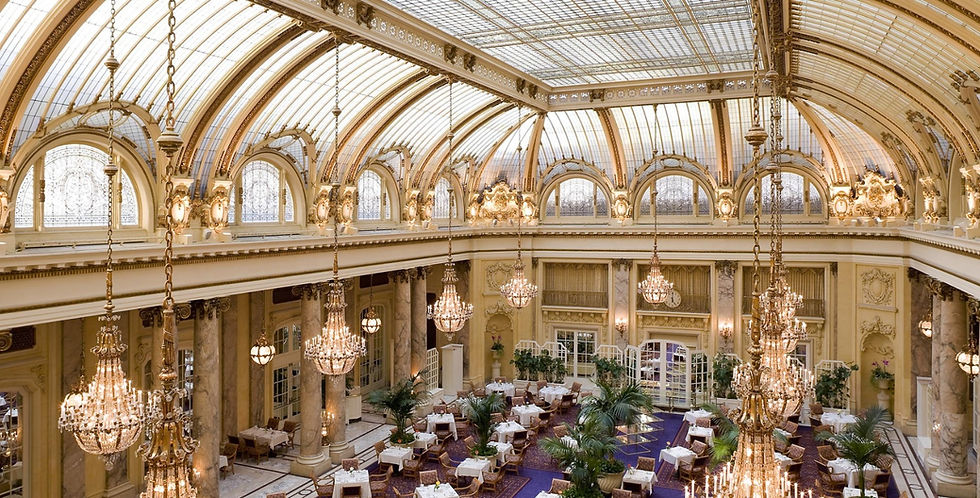
Rooms That Teach Spectacle
A ballroom teaches differently.
A good ballroom often requires less decoration than people think.
Not because it should be left alone.
Because scale, proportion, ceiling height, and focal axis are already doing part of the storytelling.
A strong room carries its own authority.
It knows where it wants the eye to travel.
It understands what it can hold.
This is where event design can become surprisingly insecure.
Many large rooms are overdecorated not because they lack beauty, but because people do not trust the authority they already have.
They compensate instead of collaborating.
They add volume where clarity was needed.
Detail where proportion might have been enough.
But the best design rarely fights the room.
It reads it.
It asks what the space is already teaching, and then decides whether to underline, soften, or interrupt that lesson.
Theater understands this instinctively.
So does opera.
No one mistakes a set for background in a well-made production.
It tells the audience how to watch.
It establishes hierarchy.
Distance.
Possibility.
Pressure.
A proscenium frames expectation long before an actor crosses it.
A smaller stage can create intensity not by lack, but by concentration.
Sightlines matter.
Thresholds matter.
Scale matters.
Silence matters.
They are not embellishments.
They are instruction.
Ritual works the same way.
This is why some celebrations feel coherent before anything much has happened.
The room has already prepared the terms.
It has made meaning easier to receive.
Not simpler.
Clearer.
The same way the concrete set of Top Girls held a difficult first act without flattening its complexity, the right ceremonial space can hold emotion, movement, hierarchy, and transition without forcing them into noise.

Rooms That Teach Intimacy
And intimacy, too, is often spatial before it is emotional.
That may be one of the things smaller theaters understand best.
In the final act of Top Girls, the centered sofa created an intimate world large enough for tension and small enough for confession.
The room taught you to lean in.
It narrowed the emotional field without closing it.
The effect had little to do with ornament.
Everything to do with spatial discipline.
Celebrations can do this as well.
A private dining room teaches closeness differently than a ballroom.
A long imperial table produces a different kind of visibility than a round one.
Candlelight alters not only atmosphere, but distance.
A lowered ceiling.
A tighter entry.
A compressed conversational zone.
These are not decorative choices alone.
They are ways of shaping how a moment is felt and how it can be shared.
Reading Before Decorating
That is why the room matters long before the décor arrives.
Or perhaps more precisely, it is why décor should begin by listening.
Not every space asks for the same intervention.
Some need softness.
Some need emphasis.
Some need only one strong gesture and the confidence to let the room continue speaking for itself.
The most effective design decisions often begin not with the question, What can we add?
But with the quieter one:
What is the room already teaching?
I have always been fascinated by that moment when a space alters behavior before anyone names the change.
The voice lowers.
The attention sharpens.
The body understands the assignment.
Long before we call it aesthetics, it is already choreography.

What Becomes Legible
And that, perhaps, is the deeper lesson.
A room does not simply contain ritual.
It organizes it.
It gives complexity form.
It allows attention to settle.
It allows intimacy to emerge.
It allows spectacle to hold.
It allows emotion to become legible.
It is never only the site of the story.
Often, it is what teaches the story how to be seen.
For a related reflection on ritual as staging, read The Theater of Power.
For a reflection on performance following architecture, read When Spectacle Becomes Ritual.
The room is never only where the story happens. It is often what teaches the story how to be seen.
Ritual Field Notes is an ongoing series exploring ceremony, symbolism, and the architecture of meaning.


Comments