
The Ritual Before the Ritual

A Ritual Field Note on arrival, anticipation, and the architecture of becoming present.
The Ceremony Begins Before It Begins
Last year, I attended several performances at Lyric Opera of Chicago. I went for the music and the theater, but I found myself paying attention to something that happened before either of them began.
The transition started outside.
People arrived carrying the residue of the city: weather, traffic, unfinished conversations, illuminated phones, the pace of wherever they had just been.

Then they crossed the entrance.
Inside, coats were removed. Tickets appeared. Voices shifted. People looked upward, toward the staircases and balconies, and then toward one another.
Clothing that might have seemed unusually formal on the street suddenly belonged to the room.
Programs were held with anticipation.
Movement became slower and more deliberate.
The curtain had not risen.
The orchestra had not begun.
Still, the audience was already being formed.

A performance has an official starting time, but its emotional beginning is less precise. It may begin when the ticket is acquired, when the clothes are chosen, or when the building first appears at the end of the street.
It may begin when a person crosses a threshold and senses that another kind of attention will soon be required.
Ceremony works in much the same way.
Its visible beginning may be marked by music, an entrance, a procession, or a spoken welcome. Yet something must happen before that moment.
The people gathered must leave ordinary time behind.
They must become present enough to receive what follows.
This is the ritual before the ritual.
The Threshold Changes the Body
A threshold is one of architecture’s smallest elements and one of ritual’s most enduring.
To cross a threshold is to move from one condition into another. The change may be physical, social, emotional, or symbolic.
Often, it is all four.
A doorway interrupts movement.
A staircase changes posture and pace.
A corridor restricts the field of vision before opening onto a larger room.
A vestibule creates a pause between exterior and interior.
These elements guide the body before the mind has fully interpreted them.
We tend to think of entrances as practical spaces. They direct circulation, protect interiors from weather, receive tickets, organize coats, and help people find their seats.
Yet they also perform quieter work.
They introduce the codes of the place.
A church entrance suggests one form of attention. A theater lobby suggests another. A garden path, a family doorway, a hotel staircase, and a candlelit corridor each prepare the guest differently.
The architecture does not need to be grand.
A modest entrance can still create a meaningful passage when it allows people to register that they have arrived somewhere particular.
That recognition matters because ceremony asks something of the body.
It asks people to sit, rise, wait, witness, respond, applaud, embrace, or remain silent. Before those gestures can hold meaning, the body must understand that it has entered a different register.
The threshold begins that instruction.
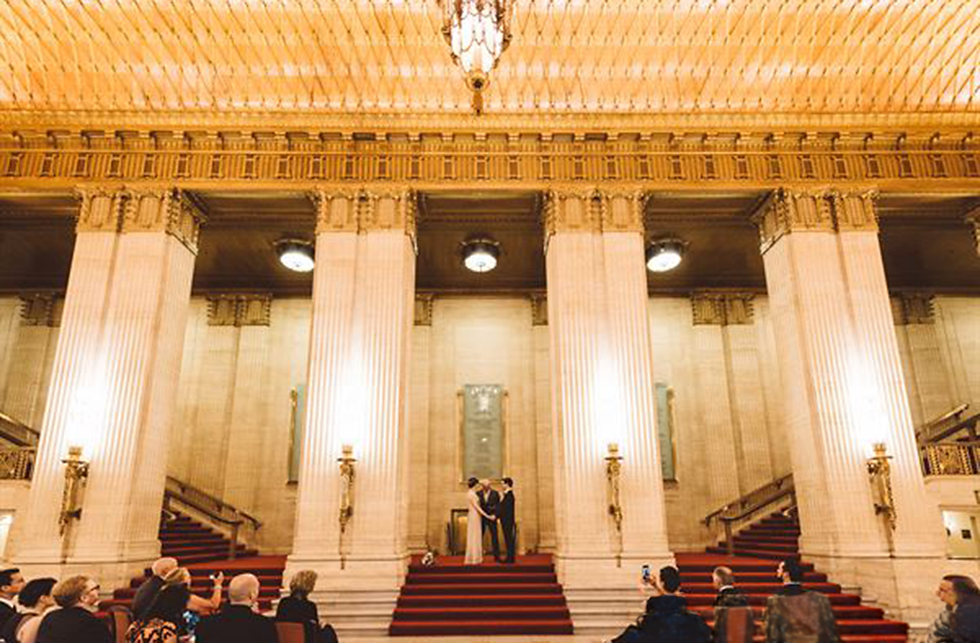
The Social Life of the Lobby
The lobby occupies an unusual place in the ceremonial sequence.
It belongs to the event, although the event has not quite started.
It is public, but many of its exchanges are intimate.
People are both arriving and observing themselves arrive.
There are greetings, introductions, small reunions, glances toward the stairs, and subtle adjustments of clothing. Someone searches for a familiar face. Someone else stands slightly apart.
People who have not yet become an audience begin to recognize that they will soon share an experience.
The lobby allows this transformation to happen gradually.
Its social life is made of anticipation. The performance ahead gives every exchange a slight charge. Even ordinary conversation is framed by what is about to occur.
Time feels temporarily suspended between the day that preceded it and the world waiting beyond the auditorium doors.
Celebrations contain similar spaces.

The church vestibule, cocktail hour, entrance courtyard, receiving room, or table where names are found can all serve as transitional environments. They offer guests a place to orient themselves socially and emotionally.
Relationships become visible.
Generations gather.
Family histories enter the same room.
People begin to understand the atmosphere and their place within it.
Much of this happens without instruction.
The room teaches through scale, sound, pacing, and the behavior of others. Guests learn whether to lower their voices, move closer, linger, look around, or proceed directly onward.
They read the occasion before anyone formally explains it.
A gathering begins to establish its character in these first minutes.
Learning to Arrive
Contemporary life has made arrival increasingly abrupt.
We move from one appointment to another with a map speaking from the dashboard. A rideshare stops at the door. A message announces that someone is outside. A digital ticket removes the need to hold anything until a screen must be presented.
The transition between places is efficient, immediate, and often emotionally invisible.
We reach destinations quickly.
Arriving is more complicated.
To arrive requires a small relinquishing. Attention must detach from what came before. The pace of the exterior world must loosen its hold.
A person must become available to the room, the people in it, and the meaning of the occasion.
Ritual has always depended on this passage.
Pilgrimages extended arrival across days or months. Religious processions gave it rhythm. Formal entrances established hierarchy and expectation. Even the act of dressing once created a longer interval between ordinary life and social ceremony.
Many of these structures have softened, which is not necessarily a loss. Ceremony evolves as culture evolves.
Yet when every transition is compressed, we risk arriving physically while remaining elsewhere in attention.
The phone intensifies this condition.
It keeps the world outside continually present inside the room. The threshold becomes porous. A guest may enter a ceremony while still reading the conversation that occupied the journey there.
This is one reason meaningful arrival now feels so distinctive.
A well-held transition creates permission to put something down: the device, the day, the hurry, the constant demand to remain reachable.
For a brief period, attention can gather around a shared event.
The Invitation as the First Threshold
Long before a guest approaches a building, another threshold has already appeared.
The invitation is an entrance made of language, material, sequence, and expectation.
It arrives within ordinary life, often among invoices, advertisements, packages, and correspondence. Yet it points toward a future time that has been set apart.

It asks the recipient to imagine a place, a gathering, and a version of herself within it.
This is why an invitation carries meaning beyond the information it contains.
Its proportions, weight, wording, typography, and method of opening begin to establish the emotional temperature of the occasion.
A fold may slow the hand.
An enclosure may reveal information gradually.
A name printed with care communicates recognition before any greeting has taken place.
The invitation begins forming the audience.
It tells the guest that she is expected. It introduces the social world she will enter and offers the first clues to its codes.
Formality, intimacy, restraint, exuberance, tradition, and experimentation can all be sensed before they are consciously named.
The object eventually disappears into a drawer, a bag, a recycling bin, or an archive.
Its ceremonial function has already begun.
It has carried the guest across the first invisible boundary, from being unaware of the gathering to anticipating it.
The physical entrance comes later.
What the Host Prepares
To host is to prepare a place for other people’s attention.
This preparation includes food, seating, beauty, comfort, and practical clarity. It also includes the less visible work of helping guests cross into the emotional life of the occasion.
A welcome can do this.
So can music heard before the central event.
A path may allow the destination to reveal itself gradually.
A person receiving guests with calm recognition may establish the tone before anything formal has occurred.
Light, sound, scent, architecture, and pace all contribute to the passage.
These gestures need not announce their importance. Their power often depends on remaining almost unnoticed.
When the transition is neglected, guests may feel that they have entered in the middle of something. They arrive uncertain, still preoccupied with logistics, looking for instructions or wondering where they belong.
The central moment is then asked to carry the full weight of transformation.
When arrival has been considered, attention accumulates.
Guests begin to understand that their presence matters.
They become aware of one another.
The room gathers them before the ritual asks them to witness, promise, celebrate, mourn, or remember.
This is hospitality as emotional architecture.
It gives people enough time to become part of what is happening.
A Ritual Field Note
At the opera, there is a moment when the lobby begins to empty.
Conversations conclude.
Programs are folded.
People move toward the auditorium and disappear through its doors.
The space that held anticipation gives way to the space of performance.
Inside, individuals take their seats and become an audience.
The transformation is subtle. No single gesture completes it. It has been accumulating since the journey began: through expectation, dress, architecture, observation, and the awareness that everyone has come to witness the same thing.
Celebration also depends upon this gathering of attention.

Its ritual begins before the vows, the music, the speech, the first course, or the entrance everyone has been waiting to see.
It begins through the sequence that carries people away from the ordinary and toward the shared.
Before people can witness a ritual, they must first be gathered into its time.
For a related reflection on how spaces influence behavior, continue with What the Room Teaches.
For a broader reflection on spectatorship and collective witnessing, read The Camera Is Now a Guest.
Ritual Field Notes is an ongoing series exploring ceremony, symbolism, authorship, and the cultural language of celebration.


Comments