
Watercolor Washes
- Karina Gaio
- Jun 21, 2025
- 3 min read

Studio Note — From the Timeless Impress Atelier
Watercolor is often misunderstood as softness alone.
It can certainly feel airy, romantic, and fluid. But what makes watercolor so compelling in stationery is not only its prettiness. It is its movement. Its ability to introduce atmosphere before a single word is read.
A wash of color can suggest light, climate, emotion, even tempo. It can make a suite feel sun-warmed, painterly, and alive without asking the design to explain itself too much.
That is where watercolor becomes most interesting.
Not when it is used as decoration alone.
When it becomes part of the invitation’s language.
Why Watercolor Changes the Mood
Some techniques sharpen a suite.
Watercolor softens it.
It introduces variation.
It interrupts flatness.
It allows color to move rather than sit still.
It creates the sense that the paper has been touched, not only printed.
This matters because invitations are not only read. They are received. And a wash of color can change how that reception feels.
A suite that might otherwise read as structured can become more relaxed.
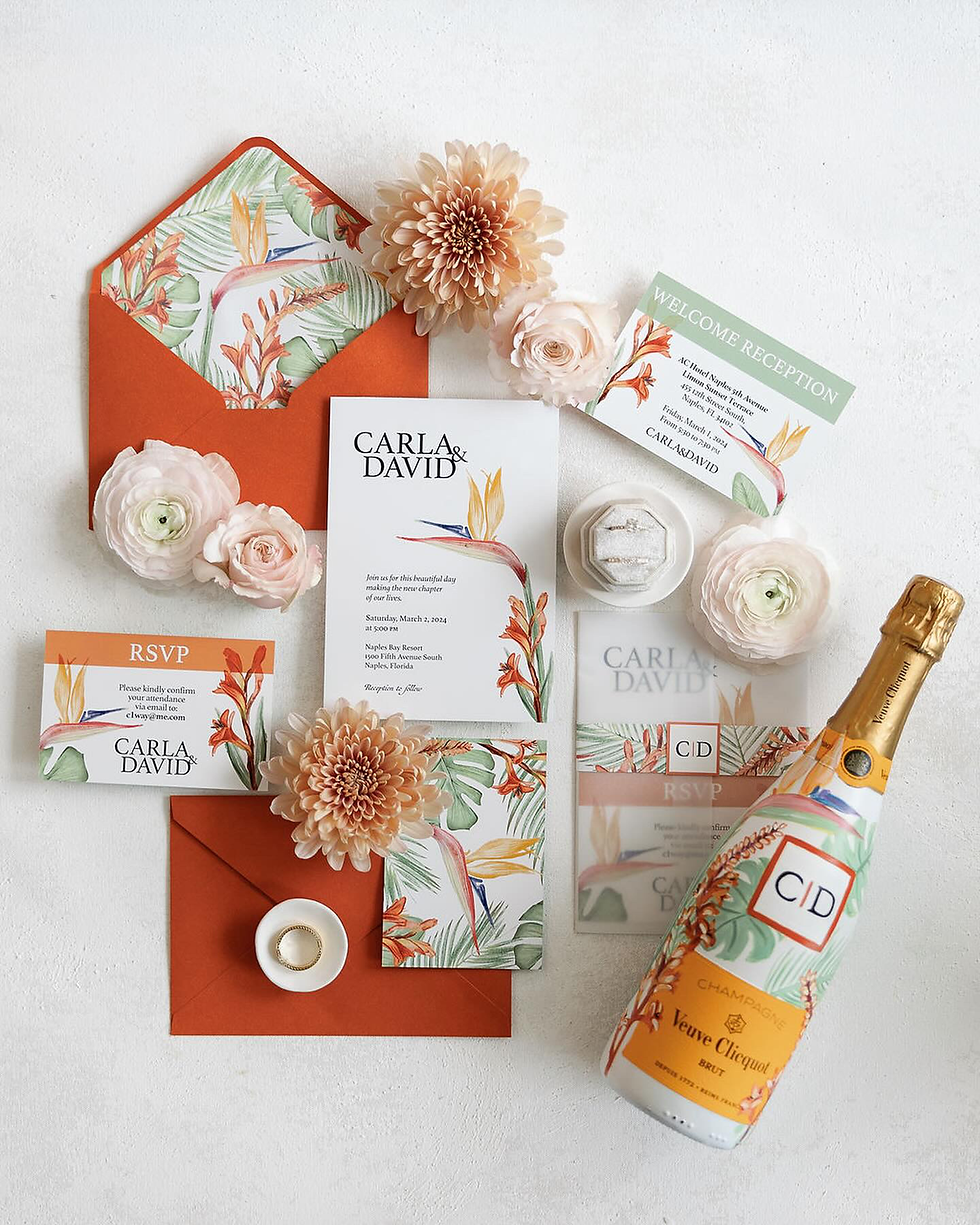
A tropical palette can feel more atmospheric than literal.
A romantic design can gain lightness rather than heaviness.
Watercolor does not need to be elaborate to make an impact.
A small gesture is often enough.

Personality Through Imperfection
One of watercolor’s quiet strengths is that it resists complete uniformity.
No two applications behave in exactly the same way. The pigment spreads differently. The edge softens unexpectedly. One wash dries slightly lighter, another with more saturation. These differences are not flaws.
They are the point.
This is part of what gives watercolor its charm in stationery. It introduces a kind of controlled unpredictability that feels more human than a perfectly flat field of color. It can carry personality without becoming loud, and artistry without becoming overworked.
That is especially valuable in a suite meant to feel bespoke.
Not because every invitation must be hand-painted in the same way, but because the overall effect can suggest something less mechanical, more alive.
What Watercolor Can Hold
Watercolor is particularly effective when a suite needs atmosphere.
It can echo sea air without painting the sea.It can suggest tropical warmth without turning literal.It can carry romance through movement rather than ornament.It can soften bright color into something more nuanced and grown.
This is why watercolor is often most successful when it supports the emotional tone of the suite rather than trying to become its sole point of interest.
The question is not only what color to use.
It is what that color should feel like once it touches paper.
Should it drift?
Glow?
Pool at the edges?
Remain translucent?
Move around the text or sit behind it like a veil?
These are design questions as much as painterly ones.
Why Restraint Still Matters
Watercolor works best when it is allowed to breathe.
A suite does not need to be saturated from edge to edge to feel expressive. In fact, one of the reasons watercolor remains elegant is that it leaves room for paper to remain paper. It creates atmosphere without removing clarity.
That balance matters.
Typography still needs to read cleanly.
The composition still needs structure.
The color still needs to support, not overwhelm.
This is where restraint becomes part of the beauty. A wash can sit quietly at the edge of the page. It can frame text with softness. It can move beneath a suite without turning the design into a painting for painting’s sake.
The best watercolor details feel integrated.
Not added afterward.
A Studio Perspective
I return to watercolor when a suite needs movement, warmth, or a certain kind of lightness that flat color alone cannot always provide.
What interests me is not the effect itself, but what it allows the invitation to communicate. A painterly texture can make a suite feel more personal, less rigid, more responsive to place and tone. It can hold joy without becoming loud. It can hold romance without turning ornamental.
And perhaps most importantly, it can make a printed piece feel touched by the hand.
That is a powerful thing.
Because stationery is at its best when it carries not only information, but atmosphere.
Watercolor does that beautifully.
Not by controlling every edge.
By letting the paper hold a little motion.
For a related reflection on how paper begins shaping tone before language fully arrives, continue with What Paper Communicates Before a Word Is Read.
For a broader Studio Note on how custom details gain meaning when they belong to a larger system, read Why a Stationery Suite Is Designed as a System.
Studio Notes is an ongoing series exploring how structure, paper, and thoughtful design shape meaningful celebrations.


Comments