
How to Make a Wedding Feel Personal

Studio Note — From the Timeless Impress Atelier
Not every couple wants a wedding theme.
In fact, many do not.
They want a celebration that feels like them, but not one reduced to a motif. Not a wedding built around one symbol, one flower, one destination reference, or one obvious concept repeated too literally.
That instinct is often right.
A personal wedding does not need a theme.
It needs a language.
And often, that language begins to take shape through the details that hold everything together.
Personal Does Not Mean Literal
A wedding becomes personal not when every element points to the same obvious reference, but when the overall design reflects the couple’s sensibility.
The place they love.
The way they host.
The colors they return to naturally.
The kind of beauty that feels familiar to them.
The emotional tone they want the gathering to hold.
This is the difference between inspiration and imitation.
A wedding inspired by travel does not need passports on the table.
A garden wedding does not need to announce itself through excess florals.
A family-centered celebration does not need to look traditional to feel deeply rooted.
The most personal weddings are often the ones that translate meaning rather than illustrate it.
A Theme Is Not the Same as a Point of View
Themes can be useful when they are loose enough to guide tone.
But the most elegant weddings are rarely built like theatrical sets.
They are built through decisions that belong to the same world.
That world might be shaped by architecture.
By a place with emotional weight.
By a shared love of old films, travel, or inherited family rituals.
By a preference for intimacy over spectacle.
By a balance between tradition and ease.
That is not a theme in the literal sense.
It is a point of view.
And a point of view will take a celebration much further than a motif ever can.

This Is Where Paper Goods Become Powerful
This is often where paper plays a far more important role than people expect.
When a couple arrives with references that feel meaningful but varied, paper goods can begin to organize them.
A color that appears once in memory can become a border, a liner, or a painted wash.
A place can become a rhythm rather than a drawing.
A family story can become a monogram, a format, or a certain degree of formality.
A personal contrast, traditional and relaxed, refined and playful, can become visible through hierarchy, material, and pacing.
Paper does not need to explain every idea.
It can translate them.
That is often what gives a wedding its first real coherence.

Let the Story Be Felt Before It Is Read
Guests do not need every reference explained to understand that a wedding feels personal.
They feel it in the consistency.
In the restraint.
In the sense that each element belongs.
A menu can feel like the couple.
A vow card can feel like the couple.
An invitation suite can feel like the couple.
Not because their names appear everywhere.
Because the design carries a recognizable voice.
This is why the most memorable wedding details rarely feel random, even when they are eclectic.
They have been interpreted through the same lens.
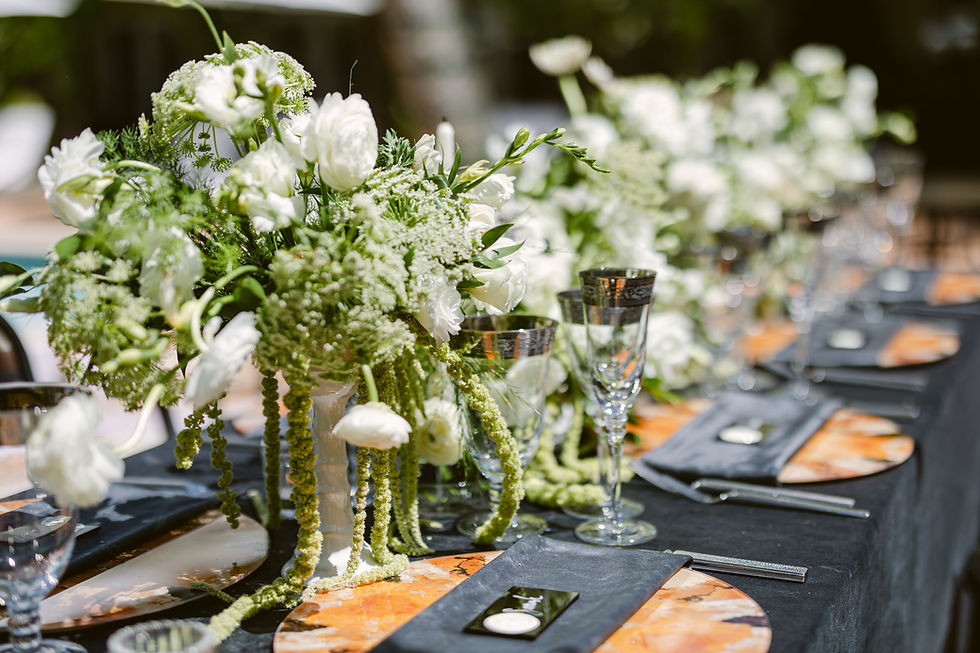
A Real Wedding Is Often Built This Way
I am seeing this clearly in a current project.
The couple is choosing elements that matter to them, references with emotional weight, and visual instincts that do not all come from the same place. On their own, those pieces could remain simply interesting. Through paper goods, they begin to speak to one another.
That is the shift.
From collection to composition.
From preference to point of view.
From beautiful pieces to a story with structure.
This is often what couples are really looking for when they say they want something personal.
Not more elements.
Better translation.

The Goal Is Recognition, Not Repetition
A personal wedding should not feel like a branded environment.
It should feel like a gathering shaped with taste, memory, and intention.
The goal is not to repeat one idea until it becomes obvious.
It is to create recognition.
A guest may not be able to name exactly why the invitation, the setting, the table, and the printed details feel so connected.
But they will feel that they do.
That is enough.
Because a wedding does not become personal when every symbol is made literal.
It becomes personal when the couple can be felt in the design without having to announce themselves in every corner.
The most elegant personal weddings are not the ones built around the most obvious theme.
They are the ones where meaning has been edited, translated, and given form with care.
That is what turns references into atmosphere.
And atmosphere into identity.
A wedding does not need a theme to feel deeply personal.
It needs a point of view strong enough to hold its details together.
This Studio Note is part of a larger conversation about structure, storytelling, and the visual language of celebration. For a related reflection on continuity across multiple events, read How to Build a Wedding Weekend That Feels Cohesive, Not Repetitive.


Comments